

Feature
Flashback February: Gary Gianni and Mark Schultz

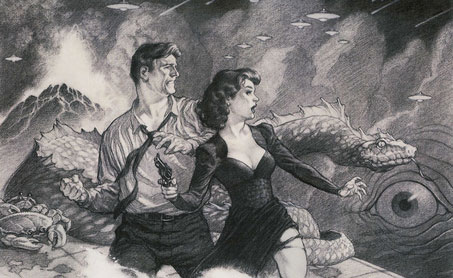
2016 is an anniversary for Tripwire. It marks the 24th anniversary of the magazine, which began back in February 1992. So for the rest of February, we shall be representing some of our classic moments over the past 23 years. Many people who have been visiting the site will probably be unaware of our print history so we thought this would be a good opportunity to get them acquainted with it. So here is our interview with Gary Gianni (Monster Men) and Mark (Xenozoic Tales) Schultz, which was originally published back in Tripwire #54, summer 2010
The Modern Adventurers
GARY GIANNI is an artist in the classic mould of 20th century illustrators while MARK SCHULTZ has carved a niche for himself as the modern successor to artists like Frank Frazetta and Al Williamson. As Flesk has published a number of their books, we thought we’d talk to them about creating adventure comics in the 21st century, working with each other and much more…
GARY GIANNI
TRIPWIRE: What is the appeal for you as an artist/ creator of adventure material?
GARY GIANNI: I hope I’m not changing the playing field here too much but the term “Adventure Material” is all encompassing. For me, the label includes stories of horror, mystery, and science fiction. Even authors generally not thought of as adventure writers like Hugo or Hemingway fall into this category. It’s the sense of Romanticism that appeals to me.
TW: What was the first adventure comic you read?
GG: The pre-super hero Marvel comics like Tales to Astonish and Strange Tales helped me learn how to read. The pictures themselves told the story (often drawn by Kirby or Ditko) and it seemed every week the world was threatened by some space invader or a giant monster. Very entertaining—even after all these years, the material holds up.
TW: Why do you think that adventure comics and fiction continues to grab reader’s attention even into the 21st century?
GG: The idea of looking over the line of our own comfort zone will always be intriguing. It’s as relevant now as it was in Homer’s time. The readers of the future will have to be a dull lot indeed not to be stirred by tales of adventure. If future readers were not “grabbed “ by heroic literature then I’ll have no part of the future. I’m going back to my own time to live and die among my own kind- readers of courage and imagination!
TW: If you had to choose, who is your favourite adventure writer and why?
GG: That’s a tough one. Robert Louis Stevenson would be high on the list. I read his work at the right age and his stories left an indelible impression.
TW: Again if you had to pick one artist whose work you admire above all others, who would you name?
GG: It would have to be Rembrandt. Every artist I admire, past or present, owes something to this man. Arguably, He was the first great teller of stories with pictures and his technical skills were extraordinary.
TW: Which writer has had the biggest impact / influence on your work and your career?
GG: I don’t really think in those terms but, commercially ,it would probably be R.E.Howard. After all, I spent six years illustrating his work. However, my influences or, maybe a more suitable word, philosophy, concerning Heroism and Romance stems from other literary sources like Hemingway, Kipling, London even Ayn Rand.
TW: You’ve worked on a number of adaptations of other writers’ work. What is it that you enjoy about adapting other people’s work?
GG: As with most readers , I look for the thing that strikes me at a personal level. Any good author will have some aspect to his work which compels the reader to leap up and ejaculate,“ He knows just how I feel!” This is the quality I wish to illustrate.
TW: You have written for other artists and written your own work. Is there a difference in the way you approach writing for other artists?
GG: I have never written material for another artist. I’ve written a lot of things for myself but I don’t think of myself as a writer.
TW: You’ve been drawing Prince Valiant written by Mark Schultz. Is that a straight scripter / artist relationship or is it more flexible than that?
GG: Mark and I work together on the general story arcs and we try to have fun with it. The week-to-week scripting is crafted through Mark’s gifted yarn-spinning skills.
TW: You are known as quite a slow artist (although with the results, that is certainly not surprising☺) but have you worked out a method of drawing faster than you would normally for Prince Valiant?
GG: ‘Slow-thinking’ might be a more apt way to describe me. Prince Valiant has extremely tight deadlines but that’s the nature of a newspaper strip. While I’m always worried about next week’s page and the ghost of Hal Foster coming to get me, the broad strokes applied at the eleventh hour sometimes surprise me. If I had more time , I’m not sure the strip would be any the better for it.
TW: You illustrated two of Wandering Star’s Robert E. Howard books. What is it about Howard’s work that over seventy years after his death, his creations continue to fascinate readers?
GG: Actually ,I illustrated Three Volumes; The Bloody Crown Of Conan, Bran Mak Morn and The Savage Tales Of Solomon Kane. Howard wrote for pulp magazines which are generally not known for their subtle nuances. But he did write with an unvarnished passion and readers respond to that quality. Isn’t that what Adventure stories are all about???
MARK SCHULTZ
TRIPWIRE: What is the appeal for you as an artist / creator of adventure material?
MARK SCHULTZ: That’s a big question. Part of the answer is rooted in my affection for the genre as a fan. “Adventure” is a very broad storytelling term and covers a lot of possibilities, but I guess what I respond to is the idea of men and women placed in extraordinary, challenging circumstances and prevailing gracefully. On that level it’s pure wish fulfillment coupled with a taste for representations of physical danger in exotic situations.
As a professional, I like working with conflict that has strong graphic possibilities. Adventure works very well in visual mediums such as comics. Of course, the best adventure stories use their action and locales to externalize conflicts within characters and to make abstract concepts relatable and entertaining.
TW: What was the first adventure comic you read?
MS: I’m not sure I can remember what exactly that would be, but I was picking up Dell’s Tarzan and Joe Kubert’s Hawkman stories early on. Turok, Son of Stone was an early favourite, too.
TW: Why do you think that adventure comics and fiction continues to grab reader’s attention even into the 21st century?
MS: For the same reason I was attracted to adventure as a fan—it’s very entertaining and allows us to envision ourselves as more capable and heroic than we actually are—simple wish fulfillment. Beyond that, if done right, it can pack an emotional punch and teach us something about ourselves and what we value. Adventure stories have been with us since at least the beginning of recorded history. It seems that all cultures respond to dramatic conflict, to the quest, to exploration of the unknown, and to sympathetic characters dealing with those elements. The elements and situations have been common no matter when or where. Adventure storytelling isn’t likely to disappear soon because we’ll always need these stories to learn about ourselves.
TW: If you had to choose, who is your favourite adventure writer and why?
MS: An unfair question! Probably, if I had to pick one who I consider to be a pretty much a pure adventure writer, it would be Robert E. Howard.
TW: Again if you had to pick one artist whose work you admire above all others, who would you name?
MS: That, too, is really impossible to boil down to one name. But, if we’re limiting the question to comics, I’ll say Hal Foster, who did so many things so well, who always got the details right, and who more or less invented dramatic storytelling for the comics.
TW: Which writer has had the biggest impact / influence on your work and your career?
MS: I really can’t reduce this to one person. A partial list: From prose, Robert E. Howard, H.P. Lovecraft and John Steinbeck (believe it or not). From comics, Harvey Kurtzman, Will Eisner and Hal Foster. From the cinema, the stories and themes developed by Howard Hawks have had a major impact on my storytelling.
TW: What is the next fiction project that will see the light of day that you have written and drawn?
MS: I’m in the midst of completing illustrations for my Storms at Sea project. It’s a novella in which, if I do things right, the prose and the images will carry something close to equal storytelling weight. It’s a mixture of adventure, crime fiction and speculative world history—sorry, that’s the best description I can come up with—and should be ready for publishing by Flesk next year.
TW: You have written for other artists and written your own work. Is there is a difference in the way you approach writing for other artists than if you were writing something you will be drawing yourself?
MS: I always take into consideration with whom I am working, and what are that artist’s particular strengths and interests. That will affect the themes, locals and characters that I use in a story. Whether I am writing for myself or for others, I like to do a full script treatment. In an ideal situation, when I know the artist with whom I’m working, I’ll discuss my initial story ideas with the artist and get his / her input. A second opinion from a good storyteller isn’t usually a bad idea and can help push things down interesting paths.
TW:You’ve been writing Prince Valiant drawn by Gary Gianni. Is that a straight scripter/ artist relationship or is it more flexible than that?
MS: As mentioned in the above question, while I’ll generally come up with the basic storyline, Gary and I will discuss that and throw ideas back and forth to refine it. Sometimes the results are only minor changes from my initial thoughts, but sometimes our talks result in the story veering off in much more interesting directions. After that, though, I’m pretty much responsible for the scripting only, and Gary takes care of the art. On the final page, Gary will edit down my text if needed to fit the artwork. On rare occasion, I’ve pitched in to help spell Gary by drawing a panel or two.
TW: Will we ever see any more Xenozoic Tales?
MS: Absolutely. I’ve got a storyline plotted that will resolve the tale I left hanging in the last issue of Xenozoic Tales, #14, tie up some loose ends, and point the way to future stories. It’ll take me about 100 pages, so I’ve got my work cut out for me. I’ve just got to find the time to get it going and doggedly chip away at it. At the rate I work, completion will be years down the road, but it is the one project more than any other that I want to get on with.
http://imgur.com/a/Dh8nT
Storms at Sea Xenozoic Tales: Vol 1
 Gary Gianni’s MonsterMen and Other Scary Stories
 Twenty-Thousand Leagues Under the Sea











You must be logged in to post a comment Login